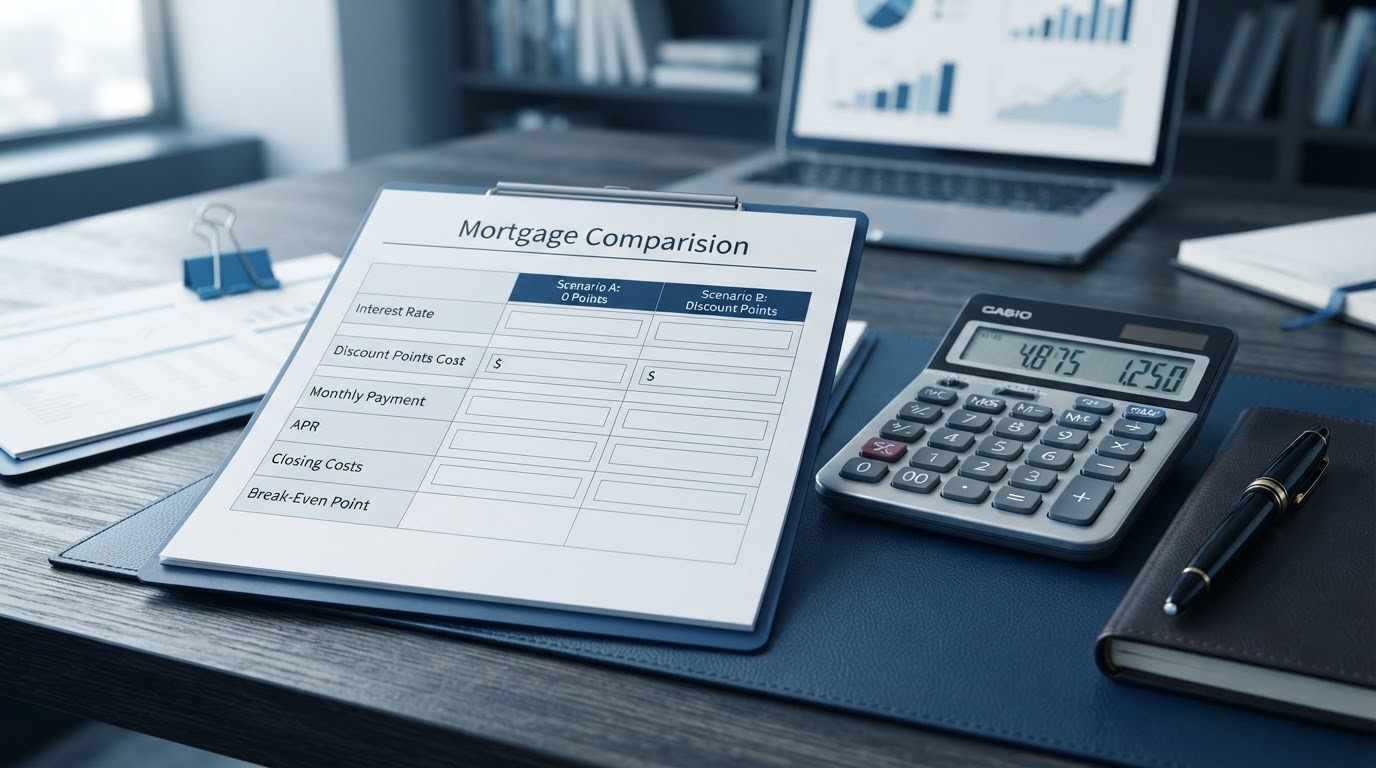
When you get a mortgage, you may be able to pay an upfront fee to lower your interest rate. That fee is called mortgage points, and the decision to pay it depends on how long you plan to keep the loan and whether the monthly savings outweigh the upfront cost. Understanding how mortgage points work helps you decide whether buying down your rate makes sense.
The short answer: mortgage points are upfront fees that lower your interest rate. Each point costs a percentage of the loan amount and reduces your rate by a set amount. Whether paying points pays off depends on how long you keep the loan. Use our mortgage calculator to compare payments at different rates.
What are mortgage points?
A mortgage point is an upfront fee you pay to the lender in exchange for a lower interest rate. One point equals 1 percent of your loan amount. Paying points is sometimes called "buying down the rate."
For example, on a $300,000 loan, one point costs $3,000. In exchange, the lender lowers your interest rate by a set amount (the exact reduction varies by lender and market).
Discount points vs. lender credits
There are two related concepts to know:
- Discount points: you pay upfront to lower your rate. Your monthly payment drops, but you pay more at closing.
- Lender credits: the lender gives you a credit at closing in exchange for a higher rate. You pay less upfront but more each month.
Points and credits are opposite sides of the same trade-off: pay more now for a lower payment later, or pay less now for a higher payment later.
How points change your monthly payment
A lower rate reduces your monthly principal and interest payment. The more points you pay, the lower your rate and your payment — up to the lender's limits.
For example (numbers are for illustration only and not a rate quote):
- A loan at 7.00 percent has a certain monthly payment.
- Paying one point might lower the rate to 6.75 percent, reducing the monthly payment.
- Paying two points might lower it further.
The exact rate reduction per point varies by lender, loan and market conditions.
Break-even calculation
The key question is whether the upfront cost of the points is worth the monthly savings. The break-even point is how long it takes for the savings to equal the cost.
A simple approach:
- Find your payment without points and with points.
- Subtract the lower payment from the higher one to get your monthly savings.
- Divide the upfront cost of the points by the monthly savings to get the number of months to break even.
If you plan to keep the loan longer than the break-even period, points may save you money. If you sell or refinance before the break-even, they may not.
An illustrative example
These numbers are for illustration only and do not represent a rate quote or a guarantee.
Suppose one point costs $3,000 and lowers your payment by $50 per month.
- Monthly savings: $50
- Upfront cost: $3,000
- Break-even: $3,000 ÷ $50 = 60 months (about 5 years)
If you keep the loan longer than 5 years, you come out ahead. If you sell or refinance before 5 years, you do not recoup the cost.
Your actual numbers depend on your loan amount, your rate reduction and your lender's pricing.
When points may make sense
Points may make sense when you:
- Plan to keep the loan for a long time (past the break-even)
- Have cash available for the upfront cost
- Want the lowest possible monthly payment
- Want to reduce the total interest you pay over the life of the loan
When points may not make sense
Points may not make sense when you:
- Plan to sell or refinance soon
- Are short on cash for closing
- Are not sure how long you will keep the loan
How to decide
- Ask your lender for rate options with and without points.
- Calculate the break-even for each option.
- Think honestly about how long you will keep the loan.
- Compare the upfront cost with your available cash.
- Consider the total savings over the time you expect to own the home.
Frequently asked questions
Are mortgage points worth it? It depends on how long you keep the loan and whether the monthly savings exceed the upfront cost. Calculate the break-even to decide.
What is one point worth? One point equals 1 percent of your loan amount. The rate reduction per point varies by lender and market.
Can I roll points into the loan? Sometimes, depending on the loan and program. Ask your lender how points can be paid.
What are lender credits? Lender credits are the opposite of points: the lender gives you a credit at closing in exchange for a higher rate, lowering your upfront cost but raising your monthly payment.
Ready to compare your rate options?
When you are ready, get a free quote or get pre-approved with Alex.
You can also call Alex Al-Ammar at (313) 992-9898 or email Alex@vestalending.com.
This article is for general information only. It is not legal, tax or financial advice. Point pricing and rate reductions vary by lender, loan and market. Figures are illustrative only. Speak with a qualified professional about your individual situation.